Meralgia Paresthetica Treatment in Hyderabad
- Home
- Conditions Treated
- Meralgia Paresthetica
Meralgia Paresthetica Treatment
Entrapment of the lateral femoral cutaneous nerve at the inguinal ligament — causing burning pain,
numbness and tingling over the outer thigh. Treated with a personalised dual approach combining
advanced non-invasive therapy and targeted nerve-nourishing medications.l
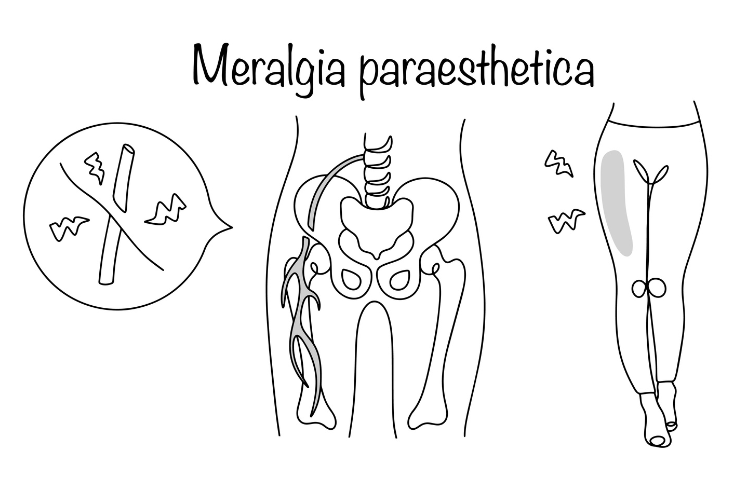
Common Risk Factors
Metabolic
Diabetes Mellitus
Diabetic neuropathy lowers the nerve's threshold for compression, making entrapment more likely.
Mechanical
Obesity & Weight Gain
Excess abdominal adiposity increases pressure on the inguinal ligament, compressing the nerve.
Mechanical
Tight Clothing & Belts
Constrictive garments exert direct mechanical pressure at the inguinal region.
Physiological
Pregnancy
Uterine enlargement shifts the pelvis and stretches the inguinal ligament.
Occupational
Prolonged Standing / Walking
Extended periods on feet increase cumulative mechanical stress at the nerve's entry point.
Post-procedural
Recent Surgery / Weight Loss
Loss of peri-inguinal fat padding or surgical scarring can expose the nerve to compression.
DIAGNOSIS
Clinical Examination + Nerve Conduction Study (NCS)
Diagnosis is established through clinical sensory mapping of the anterolateral thigh, confirmed with NCS — documenting reduced sensory nerve action potential and slowed conduction velocity of the lateral femoral cutaneous nerve. This baseline personalises the treatment protocol.
Treatment Approach
A personalised dual-modality strategy — advanced non-invasive therapy paired with targeted nerve nutrition
Treatment parameters are calibrated to the severity of nerve involvement on NCS and the patient’s specific risk profile — adjusted throughout the course based on clinical response.
A focused mechanical stimulus is applied to the inguinal region — triggering mechanotransduction at the site of nerve compression. This reduces perineural inflammation, promotes local tissue remodelling around the entrapment, and
activates neuroplastic repair within the lateral femoral cutaneous nerve. Non-invasive, outpatient, and personalised to each patient’s NCS findings.
Nerve-Nourishing Medications
Targeted neuro regenerative agents are administered alongside non-invasive therapy, creating the optimal biochemical environment for axonal repair and myelin restoration. Medication choice is personalised to the patient’s metabolic profile and underlying cause.
Symptomatic relief backed by nerve-level recovery
Patients experience resolution of burning pain and sensory loss alongside objective improvement in lateral femoral cutaneous nerve parameters on repeat NCS — confirming recovery is electrophysiologically measurable, not merelyperceived.
| What Makes Our Practice Different | |||||
|---|---|---|---|---|---|
|
Personalised Protocols
Every plan tailored to the individual
|
Advanced Technology
Cutting-edge non-invasive therapeutic science
|
Mechanism-Based Care
We treat biology, not just symptoms
|
23+ Years Experience
Decades of specialist clinical wisdom
|
Whole Person Approach
Mind, body & lifestyle integrated
|
Objective Outcomes
Measurable results — not just relief
|
Mood Disorder Treatment

Mood disorders are complex mental health conditions that disrupt emotional stability, often leading to persistent sadness, irritability, or intense mood fluctuations. Common conditions include depression, bipolar disorder, and anxiety-related mood changes, all of which can significantly impact one’s personal,
Comprehensive Evaluation by Dr. Sreekanth Vemula
Every recovery journey begins with a detailed clinical and neurological assessment by Dr. Sreekanth Vemula, a senior neurophysician with over 26 years of experience in treating neurological and neuropsychiatric disorders.
His evaluation includes:
- In-depth review of medical and emotional history
- Neurological and psychological function testing
- Identification of biochemical or structural brain factors influencing mood
This precise assessment ensures an accurate diagnosis and a fully personalized care plan.
Integrated Mood Disorder Treatment Approach
Treatment is comprehensive and tailored to each patient’s needs.
It may include:
- Medication therapy for mood stabilization and symptom control
- Psychotherapy and counseling for emotional regulation and coping skills
- Lifestyle and stress-management programs to improve resilience
- Neuromodulation therapies (when indicated) to balance brain activity and enhance emotional stability
For patients experiencing mood-related neurological symptoms such as muscle tension or dystonia, Botulinum Toxin (Botox) injections are available to improve comfort and mobility.
Services
- Epilepsy
- Dystonias
- Mood Disorders
- Vertigo
- Tinnitus
- Balance Disorders
- Obstructive Sleep Apnea
- Peripheral Neuropathy
- Migraine
- Stroke
- Trigeminal Neuralgia
- Alzheimers
- Parkinson's Disease
- Myasthenia Gravis
- Meningitis
- Bell’s Palsy
- Cerebral Palsy
- Brain Injury
- Head Injury
- Restless Leg Syndrome
- Periodic Paralysis
- Scalp Cirsoid Aneurysm
- Krabbe Disease
- Fibromyalgia