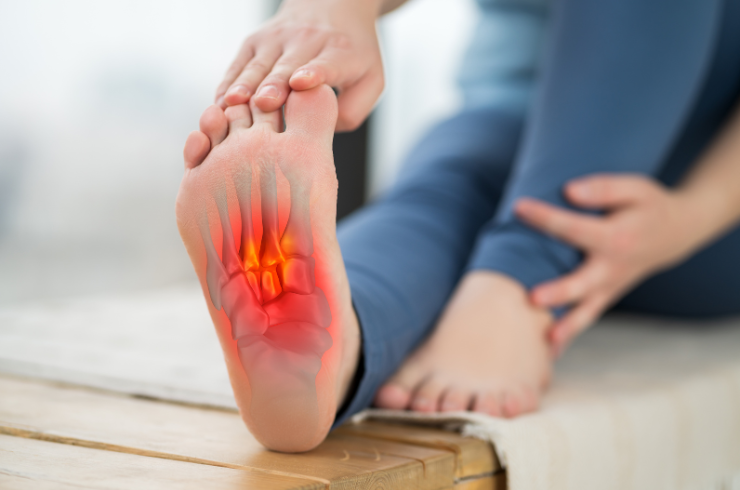
Plantar Fasciitis Treatment
A common foot condition that frequently crosses into neurological practice. We confirm the diagnosis
with clinical examination and imaging, then apply a personalised non-invasive mechanotransduction
protocol — achieving not just pain relief but objective disappearance of calcifications on follow-up
X-ray.
COMMON CAUSES
Overuse
Repetitive Micro-trauma
Common in runners and those with prolonged standing — repeated stress exceeds the fascia's repair capacity.
Biomechanical
Flat Feet / High Arches
Abnormal foot mechanics increase tension at the calcaneal insertion, accelerating degeneration.
Load
Obesity
Chronic overload of the plantar fascia accelerates degenerative change and calcification.
Age
Age-related Degeneration
Fascial degeneration peaks between 40–60 years — often presenting with heel spur formation.
Occupational
Prolonged Standing
Teachers, healthcare workers, and others on hard floors accumulate progressive fascial stress.
Chronic
Calcification
Longstanding inflammation leads to calcium deposition at the calcaneal insertion — visible on X-ray.
DIAGNOSIS
Clinical Examination + Weight-bearing X-ray
Diagnosis is established through clinical assessment of the characteristic heel pain pattern and calcaneal insertion tenderness. X-rays confirm the diagnosis, document the degree of spur formation and fascial calcification, and provide the baseline against which post-treatment imaging is compared to demonstrate calcification disappearance.
Treatment Protocol
Personalised mechanotransduction — resolving both pain and calcifications
Treatment parameters are personalised to the severity of calcification on X-ray, the degree of clinical impairment, and
the patient’s response — adjusted across the treatment course.
We apply a precise mechanical stimulus to the calcaneal insertion and fascial calcifications — triggering
mechanotransduction. This converts mechanical energy into cellular signals that fragment and resorb calcium deposits, activate tenocyte repair, and restore healthy fascial architecture. Over the course of treatment, calcifications
progressively disappear — confirmed on follow-up X-ray.
A key distinguishing feature of our approach is objective disappearance of heel calcifications over time — not merely pain relief. Follow-up X-rays after the treatment course demonstrate progressive resorption of calcaneal spurs and plantar fascial calcifications — structural healing confirmed radiologically.
Pain-free walking — confirmed on X-ray, not just by symptom relief
Patients achieve lasting pain relief alongside radiologically confirmed resorption of heel calcifications — structural
resolution of the underlying pathology. The personalised protocol ensures treatment is calibrated to each patient’s
specific calcification burden and clinical profile.
| What Makes Our Practice Different | |||||
|---|---|---|---|---|---|
|
Personalised Protocols
Every plan tailored to the individual
|
Advanced Technology
Cutting-edge non-invasive therapeutic science
|
Mechanism-Based Care
We treat biology, not just symptoms
|
23+ Years Experience
Decades of specialist clinical wisdom
|
Whole Person Approach
Mind, body & lifestyle integrated
|
Objective Outcomes
Measurable results — not just relief
|
Mood Disorder Treatment

Mood disorders are complex mental health conditions that disrupt emotional stability, often leading to persistent sadness, irritability, or intense mood fluctuations. Common conditions include depression, bipolar disorder, and anxiety-related mood changes, all of which can significantly impact one’s personal,
Comprehensive Evaluation by Dr. Sreekanth Vemula
Every recovery journey begins with a detailed clinical and neurological assessment by Dr. Sreekanth Vemula, a senior neurophysician with over 26 years of experience in treating neurological and neuropsychiatric disorders.
His evaluation includes:
- In-depth review of medical and emotional history
- Neurological and psychological function testing
- Identification of biochemical or structural brain factors influencing mood
This precise assessment ensures an accurate diagnosis and a fully personalized care plan.
Integrated Mood Disorder Treatment Approach
Treatment is comprehensive and tailored to each patient’s needs.
It may include:
- Medication therapy for mood stabilization and symptom control
- Psychotherapy and counseling for emotional regulation and coping skills
- Lifestyle and stress-management programs to improve resilience
- Neuromodulation therapies (when indicated) to balance brain activity and enhance emotional stability
For patients experiencing mood-related neurological symptoms such as muscle tension or dystonia, Botulinum Toxin (Botox) injections are available to improve comfort and mobility.
Services
- Epilepsy
- Dystonias
- Mood Disorders
- Vertigo
- Tinnitus
- Balance Disorders
- Obstructive Sleep Apnea
- Peripheral Neuropathy
- Migraine
- Stroke
- Trigeminal Neuralgia
- Alzheimers
- Parkinson's Disease
- Myasthenia Gravis
- Meningitis
- Bell’s Palsy
- Cerebral Palsy
- Brain Injury
- Head Injury
- Restless Leg Syndrome
- Periodic Paralysis
- Scalp Cirsoid Aneurysm
- Krabbe Disease
- Fibromyalgia